Adventure Medical Kits - Adventure Discussions
     Posts Tagged ‘QuikClot’

“Ask the Doc” Mailbag Round-Up for April 2010

Tuesday, April 27th, 2010

Q:  used the heatsheets emergency bivvy (3.8 oz). next morning discovered a lot of moisture in the bivvy. this gave rise to an extra cold and damp start to the day. is this a common with the bivvy? many thanks for a small but important bit of kit. it may not seem like the back country but when i am here in northern ireland events can turn bad.

A:  Condensation inside the bivvy is par for the course with this product – since the material itself is not breathable, moisture accumulates fairly rapidly.  This is why we classify the Heatsheets Bivvy as an emergency product – since, in an emergency, it is necessary to preserve heat and get warm at all costs, even if condensation results.

Q: I have to prepare a medical kit for 40 people in a wilderness setting and being “waterproof” is a must so we don’t lose supplies.  What Adventure Medical Kit do I need?  My wife is a retired R.N., so we would also like something that has a stapler as well as sutures in it.

A: A kit for 40 people is going to need to be pretty large – I would recommend either our Guide I or Expedition kits from our Professional Series.  These kits have enough supplies to treat a wide range of ailments and injuries over a large group of people, and they are designed for professionals or individuals with advanced wilderness first aid training.  (For a more user friendly option, I highly recommend our Comprehensive kit, which features Easy Care organization so even someone without any first aid training can administer medical care.)  All of our kits in the Professional series use water-resistant fabrics, although they aren’t 100% waterproof – for a kit as large as what you’re looking for, I would recommend keeping it in a waterproof container such as a Pelican case, Otter box, or even a very large size Aloksak; alternatively, you can pack the inner components into zip-lock bags to keep them dry in the event that the kit is submerged.

As for sutures/surgical supplies, I recommend picking up a Deluxe Wound Cleaning and Closure module from our refills page – this module is for professionals only, and it contains sutures as well as a skin stapler and staple remover.

Q: Would it be safe to put the Quikclot sport silver after I’ve use neosporin on a gauze?

A: QuikClot (and QuikClot Silver) are designed to be used in an emergency situation when bleeding is heavy or life-threatening.  If the amount of bleeding has slowed enough for you to dress the wound properly (with gauze and antibiotic ointment), it probably isn’t necessary to use QuikClot.  In answer to your question, it is safe to use QuikClot or QuikClot Silver in this situation, but my advice would be to use QuikClot directly on the wound immediately, hold it in place using direct pressure for as long as is necessary to stop the bleeding, and then to use antibiotic ointment, non-adherent dressings, and gauze to dress the wound once bleeding has stopped.

Q: What is the best kit for horseback riding? We ride in the mountains often, and sometimes get far from camp.

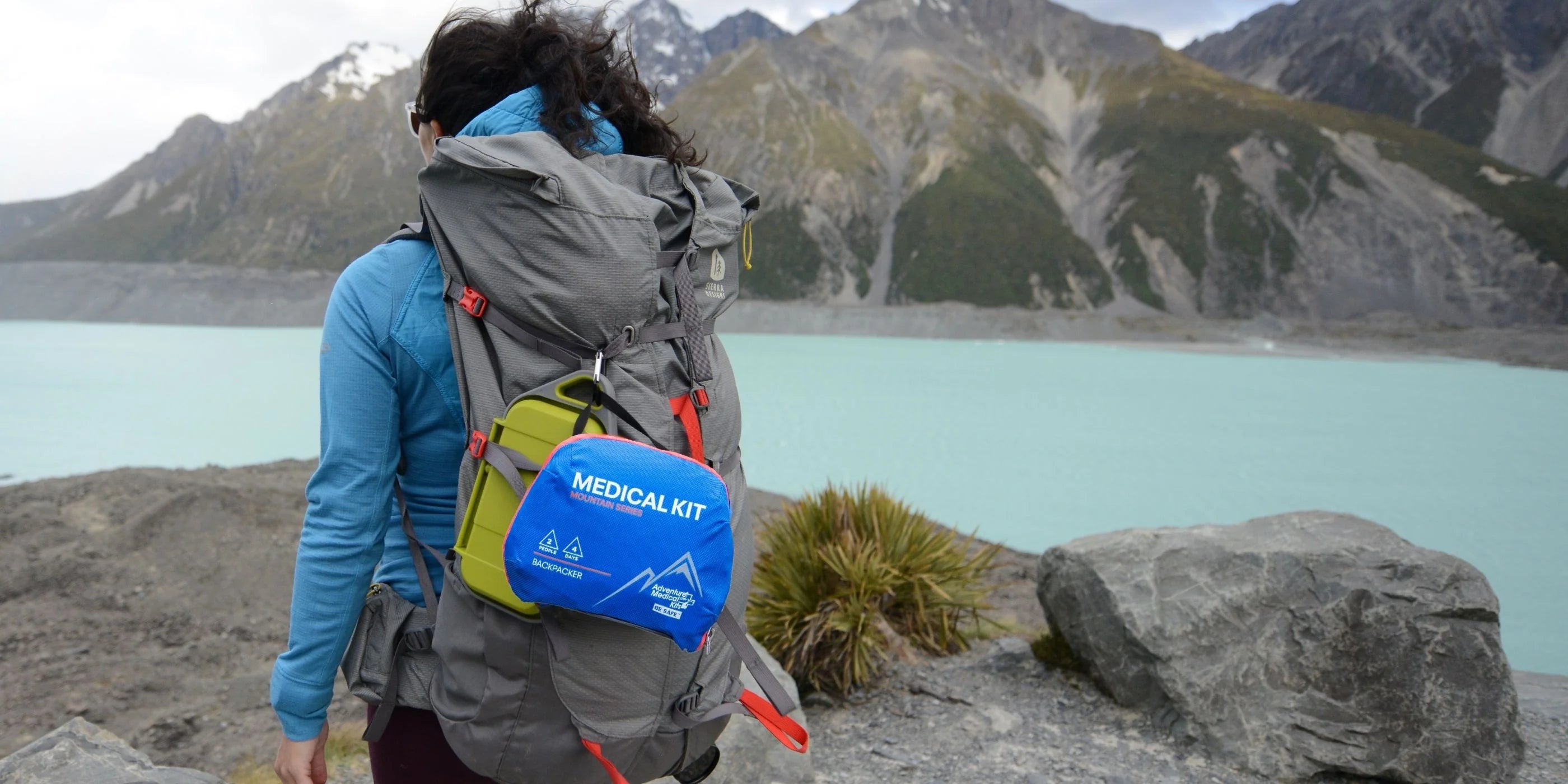
A: I suggest either our Comprehensive or Outfitter, since these kits both have detachable inner bags that you can take with you on excursions from your base camp.  Both of the kits have enough supplies for large groups or extended trips, so if you’re venturing out with smaller groups on shorter trips, you may want to consider the Weekender or Sportsman kits instead.  The Comprehensive and Weekender kits are from our Mountain series, which will suit your needs if you just ride horses to get out into the wilderness, while the Outfitter and Sportsman kits are specifically designed for hunting/fishing trips.

Q: I will be directing an archaeological project in the lower Andean mountains of Peru (ca. 1000m).  We will have a crew of four people and will be working for about a month.  It is five hours by horse to the nearest road and then four hours by truck to the nearest town. We will have supplies brought in once a week and each crew member is expected to bring in their own basic supplies.  We can get most basic supplies in Peru (boxes of gauze, bandages, eye flush, antiseptic wipes, etc,) but I am concerned with a major machete cut.  Snake bites and burns are second and third on my list.  Any suggestions for kits.

A: I would recommend the Comprehensive kit from our Mountain Series for your needs (four people in a remote location for 30 days).  Although you can obtain basic supplies, it really is preferable to have everything contained in one kit, especially one like the Comprehensive in which the contents are organized by injury.  If you are particularly worried about major cuts/bleeding, pick up a Wound Closure Medic, which as everything you need to clean and close a wound, as well as some QuikClot Sport, which will stop bleeding within minutes.

-Jordan Hurder, AMK Product Specialist

Ask the Doc – QuikClot Question

Thursday, October 22nd, 2009

Question:

I have a question about QuikClot – does it work and is it contraindicated for any type of injury?

Thanks,  Michael Z.

Answer:

Hi Michael-

Thanks for your question about QuikClot.  In short: yes, QuikClot is very effective at speeding the clotting process.  It has been tested in numerous clinical trials and in real world situations involving military, law enforcement, and emergency first response personnel.  The formula that we use does not generate heat (like the “old” QuikClot) and thus will not leave burns on the wound site.

Also, because the mineral that constitutes QuikClot is chemically inert, contraindications are very rare.  The only injury in which I would recommend not using QuikClot is one immediately around the eye (in which there is a possibility that QuikClot will come into contact with the eyeball), since it is an eye irritant.

Please let me know if you have any further questions, and thanks again for your interest.
Best,

Jordan Hurder
Product Specialist

What Do I Need In a Medical Kit for Skydiving?

Wednesday, May 20th, 2009

Question:
I want to build a first aid kit for our Drop Zone and would like your recommendations on contents for skydiving related incidents. I know all the basic items but would like your thoughts on splints and slings etc.While small cuts and sprained ankles etc are what we see most, we should be prepared for more serious incidents to include broken bones, puncture wounds (in the event of a tree landing)etc. If you could email me a list I would greatly appreciate it.

Answer:
Kevin, I would use the Fundamentals kit in our Mountain Series and add a QuikClot Dressing to stop severe bleeding. This kit will have everything you need from splinting fractures to wrapping sprains and dealing with puncture wounds. The Comprehensive Guide to Wilderness & Travel Medicine included in the kit will describe how to use the supplies. Once you buy the kit and register it you can enjoy 25% off your refill supplies if you need to refurbish.

Thanks for the question.

Frank Meyer

Marketing Director/Co-Founder

ASK YOUR QUESTION >>> CLICK HERE

Should I Add a Hemostatic Agent to My First Aid Kit?

Tuesday, April 14th, 2009

Question:

Do you recommend adding Celox powder to first aid kits? My situation is carrying the master FAK for a crew of 8-10 scouts and adults for 10+ days backpacking at Philmont.

Thanks, Dan

Answer:

Dear Dan,

I do recommend carrying a “Hemostatic dressing” for adventures like yours where the activities are higher risk and the remoteness of your adventure means professional medical care will not arrive quickly.

AMK prefers using QuikClot® instead of Celox because of its ease of use. QuikClot® contains the mineral zeolite which has a tremendous capacity to absorb fluids. The zeolite is contained in a sterile mesh pouch which you simply place over the wound and apply direct pressure. The zeolite beads quickly absorb the smaller water molecules out of the blood and leaves the platelets and other clotting factors in the wound to form a strong clot.

The advantage to a mesh pouch is that in higher wind conditions the beads won’t blow away and you can apply the QuikClot® dressing no matter what position the patient is in i.e. hanging from a harness or rope. When QuikClot® first came out it was a pretty “hot” clotting agent. Temperatures of the dressing would reach 135F. causing burns to the skin. QuikClot® is now pre-loaded with water so that the dressing reaches only 105F, about the temperature of a hot tub. What is interesting to note is why the QuikClot® dressing gets hot. The heat in the dressing is generated by the speed of the water molecules moving from the blood to the zeolite mineral beads.

You can buy QuikClot® here. or click here to learn more.

Have a great trip.

Frank Meyer
Adventure Medical Kits
Marketing Director and Co-Founder

ASK YOUR QUESTION>>> CLICK HERE

Which kit to purchase?

Friday, November 14th, 2008

Question:

1) I am a field member on our county Search & Rescue team. 2) I will be finishing with my Wilderness First responder certification in a few weeks. 3) I spend tons of time in the back country of colorado year round. From ice climbing to mountain biking. I have always carried a small field first aid kit, have have added more and more items over the years.

Can you recommend a kit (for personal use) that I could use while hiking, biking, climbing, etc… in very reomte areas that can deal with everything from allergies to major trauma.

Thanks,

Nathan T., Secretary Garfield County Search & Rescue

Answer:

Nathan, I would carry the Ultralight & Watertight .9 kit and add QuikClot, an Epi-pen and a small CPR shield. You can find the Quicklot and CPR mask in our refill your kit section. The Epi-Pen you will need a prescription and go to your local pharmacy. Thanks